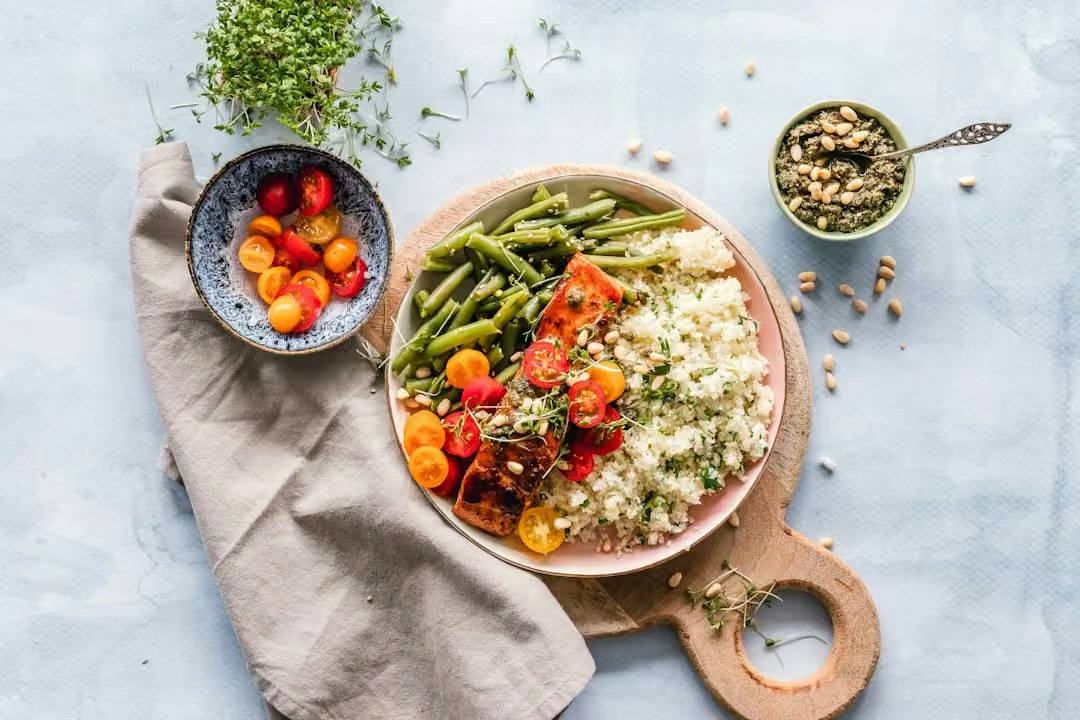
How much protein is useful, how to spread it across meals, and how plant foods and supplements fit—without turning nutrition into a daily mathematics exam.
Protein advice has become strangely competitive. More grams. More meals. More expensive powders. A tighter schedule. Somewhere in the noise, a simple question gets lost: what would make your ordinary day work better?
For most recreational lifters, I would start there—not with the most complicated nutrition protocol used by someone preparing for a competition.
Build adequate intake, choose foods you enjoy, and keep resistance training at the center of the plan. Then consider whether any finer detail actually needs attention.
“Make protein easy to repeat before you try to make it perfect.”
Use a target as a guide, not a test of commitment
A large meta-analysis found that protein supplementation modestly improved resistance-training gains, with an estimated average plateau for gains in fat-free mass around 1.6 grams per kilogram of body weight per day. The uncertainty around that estimate was substantial; it is not a precise biological cutoff for every individual. [1]
Sports-nutrition guidance commonly places many healthy exercising adults around 1.4–2.0 grams per kilogram daily, with requirements changing according to training, energy intake, and individual circumstances. [2]
For an illustrative 75-kilogram adult, 1.6 grams per kilogram equals about 120 grams daily. That calculation gives the person a planning reference—not a medical prescription or a reason to worry about finishing a day at 117 grams.
People with kidney disease, prescribed protein restrictions, significant obesity, pregnancy, or other clinical circumstances should not automatically multiply a sports target by their current weight. Individual advice matters.
Find the weak meal before adding another shake
Look at a normal day. Is breakfast mostly coffee? Does lunch contain a real protein source, or only a small garnish? Does almost all your protein arrive at dinner?
I suggest fixing the least complete meal first. Add yogurt or a suitable fortified alternative, eggs, tofu, fish, poultry, legumes, or another food that fits your diet. The purpose is to make the daily total easier to reach—not to produce four identical meals.
Distributing protein across eating occasions is a reasonable practical strategy. However, meal-level muscle-protein-synthesis research does not establish that everyone needs an exactly even schedule to maximize long-term growth. Daily intake and the training context remain central. [2,4]
For the illustrative 120-gram day, four eating occasions averaging about 30 grams provide a simple example. Three meals with different amounts can also be workable. Use labels or a reliable food database when precision is genuinely useful, then simplify the routine once you understand it.
Plant or animal protein? Ask a better question
“Which side wins?” is less useful than “does this diet provide enough appropriate protein and meet the person’s wider nutritional needs?”
A 12-week study compared habitual young male vegans and omnivores during supervised resistance training. With protein matched around 1.6 grams per kilogram daily, using soy or whey supplementation where needed, both groups improved similarly in the measured muscle and strength outcomes. Participants were not randomly assigned to become vegan or omnivorous. [3]
That is useful evidence, but it is not proof that every plant food is interchangeable with every animal food, or that the result applies identically to frail older adults.
My practical approach is to identify substantial protein sources instead of relying on the label “plant-based” or “high-protein.” For a plant-focused diet, that could include tofu, tempeh, soy foods, legumes, and an appropriate protein powder when convenient. For an omnivorous diet, the same planning question still applies: what is supplying the protein in this meal?
A well-planned diet also needs attention beyond protein. Do not let a muscle-building target become an excuse to ignore food variety.
Treat supplements as tools for convenience
A powder can solve a practical problem. You may be traveling, short of preparation time, or struggling to meet an agreed intake through ordinary meals.
That does not make the powder more important than those meals. Nor does the word “protein” make a product automatically useful for your budget or goals.
Before buying anything, I would ask three questions: what gap is this filling, what does one actual serving provide, and will I use it consistently? Sports guidance recognizes both food and supplements as ways to provide protein. [2]
Avoid turning supplementation into an open-ended stack. A product that adds more of something you already get sufficiently may contribute less than the advertising suggests.
For allergies, gastrointestinal symptoms, or medication and health concerns, choose products with appropriate professional advice. A convenient food should not create an avoidable problem.
Put timing in its proper place
Eating protein around training can be useful, especially when it helps organize your day. A pre-sleep serving can also be an option. Neither creates a requirement to drink a shake at an exact minute. [4]
My coaching question is practical: when was your last meal, when will the next one be, and will your plan leave a long, unintended gap?
Training after a normal meal and eating dinner afterward is a different situation from exercising fasted and then skipping food for most of the day. The response should reflect the situation, not a rigid stopwatch rule.
The same logic applies on rest days. Rather than redesigning the whole diet, keep the protein routine straightforward and adjust other portions according to your overall plan.
A consistent pattern is easier to evaluate than an elaborate schedule followed for three days and abandoned for four.
Frequently asked questions
Is protein above 1.6 grams per kilogram wasted?
No. The figure is an estimated average breakpoint for a particular training outcome, not an absorption ceiling or a line beyond which food becomes useless. It also does not mean more always produces more muscle. [1]
Do I need a shake immediately after lifting?
Usually there is no need to treat the end of the workout as an emergency. Consider the meals around it and the total day. [4]
Can I build muscle while eating a vegan diet?
Yes, it is possible. The available training evidence supports the feasibility of appropriately planned high-protein plant-based diets, while not proving that all diets or populations respond identically. [3]
Summary
Protein should make your training diet more useful—not make your life smaller.
Choose a sensible target for your circumstances. Improve the meals that need it. Use supplements only when they solve a practical problem. Then put your attention back on the training that gives the nutrition a purpose.
Your next step: review one normal day of food and improve its weakest protein-containing meal. Start with the gap you can actually see.
Disclaimer
Disclaimer: The information provided in our articles is for informational purposes only and is not intended to be a substitute for professional medical advice, diagnosis, or treatment.
Sources
- Morton RW, et al. (2018). A systematic review, meta-analysis and meta-regression of the effect of protein supplementation on resistance training-induced gains in muscle mass and strength in healthy adults. British Journal of Sports Medicine, 52, 376–384. doi:10.1136/bjsports-2017-097608.
- Jäger R, et al. (2017). International Society of Sports Nutrition Position Stand: protein and exercise. Journal of the International Society of Sports Nutrition, 14, 20. doi:10.1186/s12970-017-0177-8.
- Hevia-Larraín V, et al. (2021). High-Protein Plant-Based Diet Versus a Protein-Matched Omnivorous Diet to Support Resistance Training Adaptations: A Comparison Between Habitual Vegans and Omnivores. Sports Medicine, 51, 1317–1330. doi:10.1007/s40279-021-01434-9.
- Kerksick CM, et al. (2017). International society of sports nutrition position stand: nutrient timing. Journal of the International Society of Sports Nutrition, 14, 33. doi:10.1186/s12970-017-0189-4.




Add comment