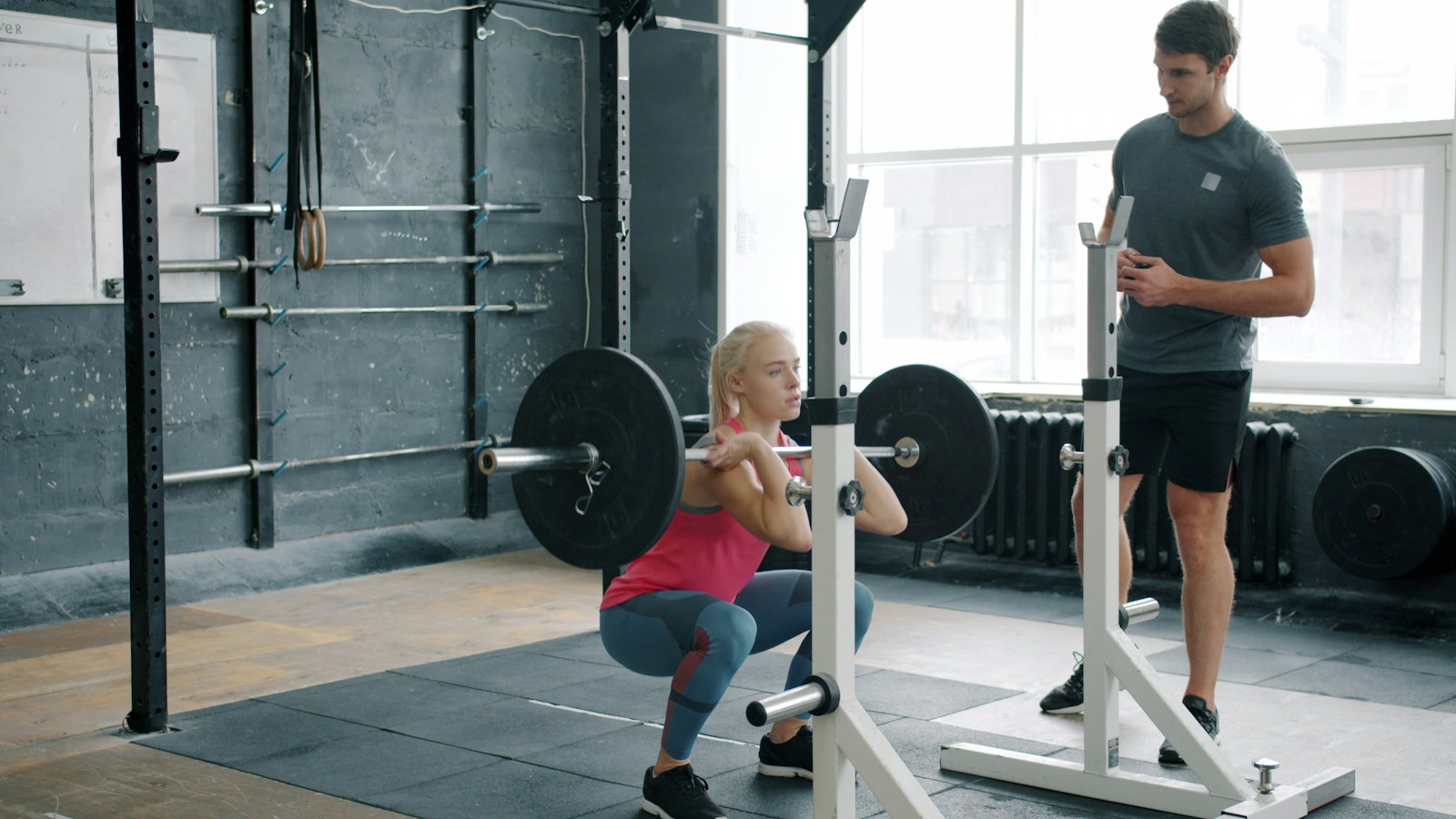
Squats or hip thrusts: which should you choose if you want to develop your glutes? Both appear in popular gym routines, yet online advice often turns them into competing answers to the same question.
A more useful starting point is what you want from your training and how the exercises fit together. Understanding their differences can help you recognise a sensible programme without having to build every workout yourself.
Two movements with different setups
In a squat, you bend at the knees and hips, then stand back up. In a hip thrust, your upper back is usually supported on a bench as you raise and lower your hips. These are distinct skills with different equipment arrangements and movement patterns.
That matters when choosing an exercise. You may enjoy the standing movement of a squat, prefer the setup of a hip thrust, or want to practise both. Consider the equipment you have available and how clearly you understand the movement. An exercise’s popularity does not tell you how comfortably you can set it up in your own gym.
Squats or hip thrusts: what does the study mean for you?
Both exercises can help develop your glutes. In a nine-week study of 34 women and men with no strength-training experience, researchers used MRI to measure muscle changes. The squat and hip-thrust groups achieved similar growth in the gluteus maximus, while squats produced more growth in the front and inner thighs. [1]
How can you use this in your training? If you want to develop both your glutes and thighs, squats are a sensible choice. If you prefer more focused glute work, hip thrusts are a suitable option. Let your goals and the movement you feel confident performing guide your choice.
This was a short study in beginners that compared the exercises separately. It does not tell us whether combining them produces better results. Your plan can include both, depending on your goals and the other exercises in your week.
Foxy · Women-only training
Explore Foxy, a women-only, glute-focused training plan with workouts delivered in the app.
Women-only · Workouts delivered in the app
Look at the plan around the exercise
Knowing an exercise name is only the beginning. A usable workout also tells you where it belongs, how many sets and repetitions to perform, and what the instructions mean. Collecting appealing movements from different videos leaves those decisions to you.
This is where a curated programme can make training simpler. The supplied Foxy sample blocks include a squat emphasis in Month 3 and a hip-thrust emphasis in Month 4. The exercises sit within three main full-body sessions, so glute training has a defined place alongside the rest of your strength work.
New workouts arrive every four to five weeks, and each exercise has an instructional video. You can review the movement that actually appears in your session, including the specific variation, rather than searching for a demonstration and wondering whether it matches.
A glute focus can belong in a full-body routine
Wanting to develop your glutes does not mean every exercise in your week has to target them. You may also want to feel more confident with upper-body movements and follow a routine that gives the rest of your training a clear structure.
Foxy brings those priorities together through its Monday, Wednesday and Friday full-body sessions. Two optional glute workouts provide another choice when additional focus suits your week. Their availability does not change the three-session foundation.
Foxy · Women-only training
Explore Foxy, a women-only, glute-focused training plan with workouts delivered in the app.
Women-only · Workouts delivered in the app
What to check before choosing your programme
Look beyond the headline exercise. Check whether the programme explains the session structure, demonstrates the movements and fits the equipment you can access. These practical details help you understand what you will actually do when you arrive at the gym.
Also consider how much planning you want to handle yourself. If choosing and arranging exercises is the part that keeps holding you up, a prepared training block may be more useful than another list of favourite glute movements.
Explore Foxy from Todoroff Performance to see how its full-body structure and glute focus fit the way you want to train.
Disclaimer
Disclaimer: The information provided in our articles is for informational purposes only and is not intended to be a substitute for professional medical advice, diagnosis, or treatment.
Sources
- Plotkin et al. (2023): squat and hip-thrust training trial. Frontiers in Physiology.


Add comment